
6-Month-Old Feeding Schedule: First Tastes Around Milk
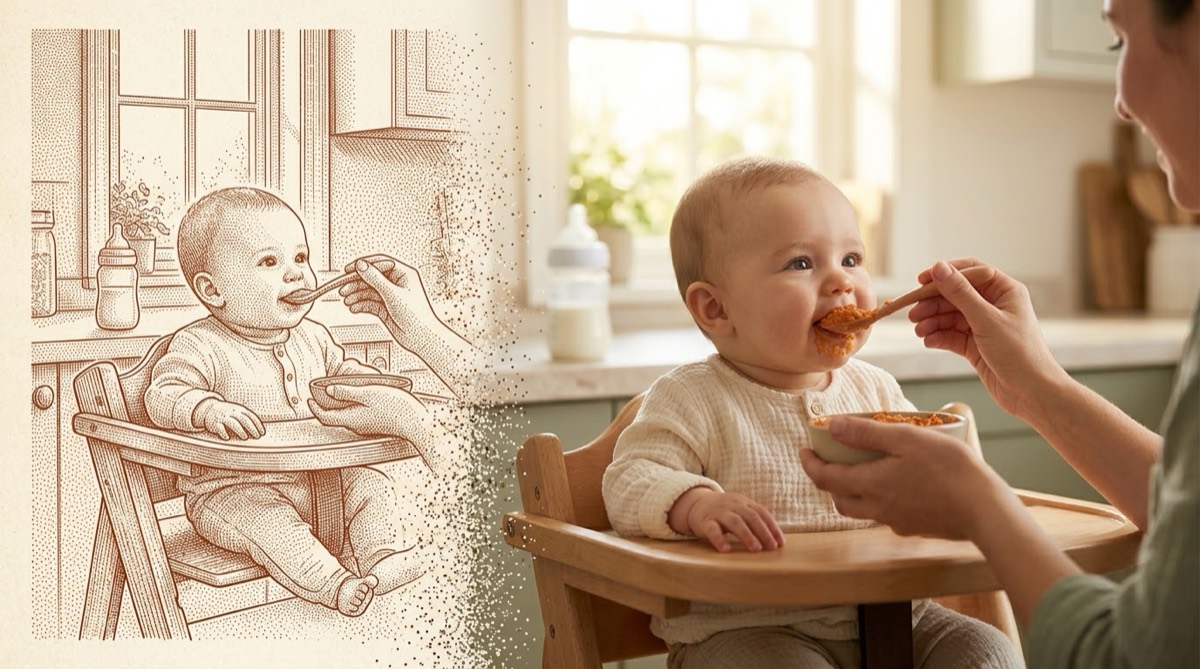
At 6 months, breast milk or formula is still almost all of baby’s nutrition. Solids start as one small meal a day, at a time when baby is awake, calm and a little hungry.
Quick answer
A typical 6-month-old has breast milk on demand (often 6 to 8 feeds) or about 24 to 32 oz (710 to 950 mL) of formula a day, plus 1 solid meal of a few spoonfuls or a few munches of finger food. Offer solids 30 to 60 minutes after a milk feed, keep meals to 10 to 15 minutes, and start the top allergens, like peanut and egg, in the first weeks. Most 6-month-olds take 3 naps with 2 to 2.5 hour wake windows.
- Breast milk or formula is still the main food: on demand or 24–32 oz formula a day
- Start with 1 solid meal, 30–60 minutes after a milk feed
- Include iron-rich foods and start the top allergens early
Golden Rule • Milk First, Solids Second
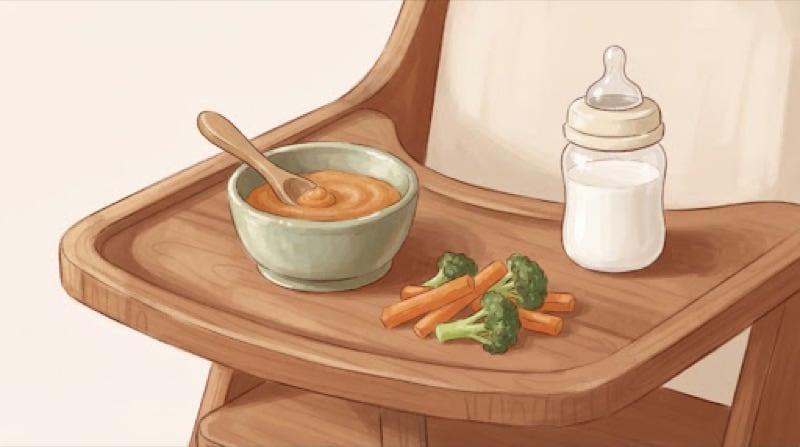
Offer solids about 30 to 60 minutes after a milk feed. Baby is not starving, so they are curious instead of frustrated, and breast milk or formula stays the main source of calories.
A sample day
A sample day for a 6-month-old: milk on waking and after naps, one solid meal late morning.
- 7:00AM
Milk feed 1
Morning Wake & Feed
A full breast milk or formula feed (about 6–8 oz formula).
Daylight helps set the body clock.
- 9:00to 10:15 AM
Nap 1 · 1.25 hrs
Morning Nap
First nap after about 2 hours awake.
Wake window: ~2 hours.
- 10:15AM
Milk feed 2
Post-Nap Feed
Breast milk or formula after waking.
Then floor play and tummy time.
- 11:00AM
Meal 1
First Meal of the Day
Thick iron-rich puree on a pre-loaded spoon, or a large soft finger food. Example: mashed lentils with avocado, or a soft sweet potato wedge.
 Lentils
 Avocado
10–15 min • 1–2 oz open cup water
- 12:30to 2:00 PM
Nap 2 · 1.5 hrs
Midday Nap
Usually the longest nap of the day.
Wake window: ~2.25 hours.
- 2:00PM
Milk feed 3
Afternoon Feed
Breast milk or formula after the nap.
Short walk or outdoor time.
- 4:30to 5:00 PM
Catnap · 30 min
Late Afternoon Catnap
A short nap to bridge to bedtime. Stroller and contact naps count.
Wake window: ~2.5 hours.
- 5:30PM
Milk feed 4
Early Evening Feed
A top-up feed before the bedtime routine.
Breastfed babies may cluster feed now.
- 6:45PM
Milk feed 5
Bath, Story & Bedtime Feed
Calm final feed in a dim room.
Keep lights low.
- 7:15PM
Night sleep
11–12 Hour Night Sleep
1 to 2 night feeds are still common and normal at 6 months.
Total daily sleep: 12–15 hours.
How much should a 6-month-old eat?
These are typical ranges. Baby decides how much; follow hunger and fullness cues.
| Food | Typical amount | Notes |
|---|---|---|
| Formula | 24–32 oz (710–950 mL) a day | 4–6 bottles of 6–8 oz |
| Breast milk | On demand, often 6–8 feeds | Don’t cut feeds to make room for solids |
| Solids | 1 meal, 1–4 tablespoons in total | Some days baby eats almost nothing; that’s fine |
| Water | Sips, up to about 4–8 oz (120–240 mL) a day | From an open or straw cup with meals |
| Juice / cow’s milk to drink | None | Wait until 12 months |
Iron stores run low from about 6 months, so offer an iron-rich food at the daily meal: meat, fish, egg, lentils, tofu or iron-fortified cereal. See iron-rich foods.
Shapes That Work at 6 Months
At 6 months, babies rake food with the whole hand. Offer finger-length strips they can hold with food sticking out of the fist, or thick purees on a pre-loaded spoon.
Roasted Sweet Potato Wedges
Roast until very soft. Leave a little skin on for grip.
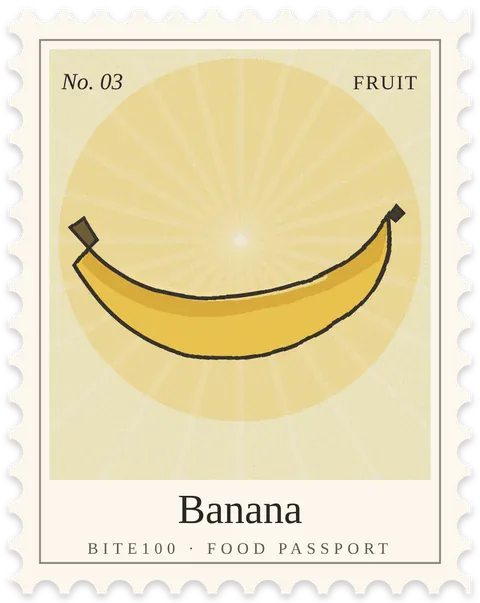
Banana “Handle”
Cut a banana in half and peel the top part, leaving the peel on the bottom as a handle.
“At 6 months, solids are practice. If baby eats two bites today and none tomorrow, breast milk or formula has them covered. The win is showing up to the table.”
Follow the cues
Leaning in and opening the mouth means more. Turning away or pushing food off means done.
One meal is enough
One relaxed meal a day is plenty this month. Add a second when baby seems keen, usually around 7 months.
Let them squish
Touching and smearing food is how babies learn about it before they eat it.
Your first week of solids
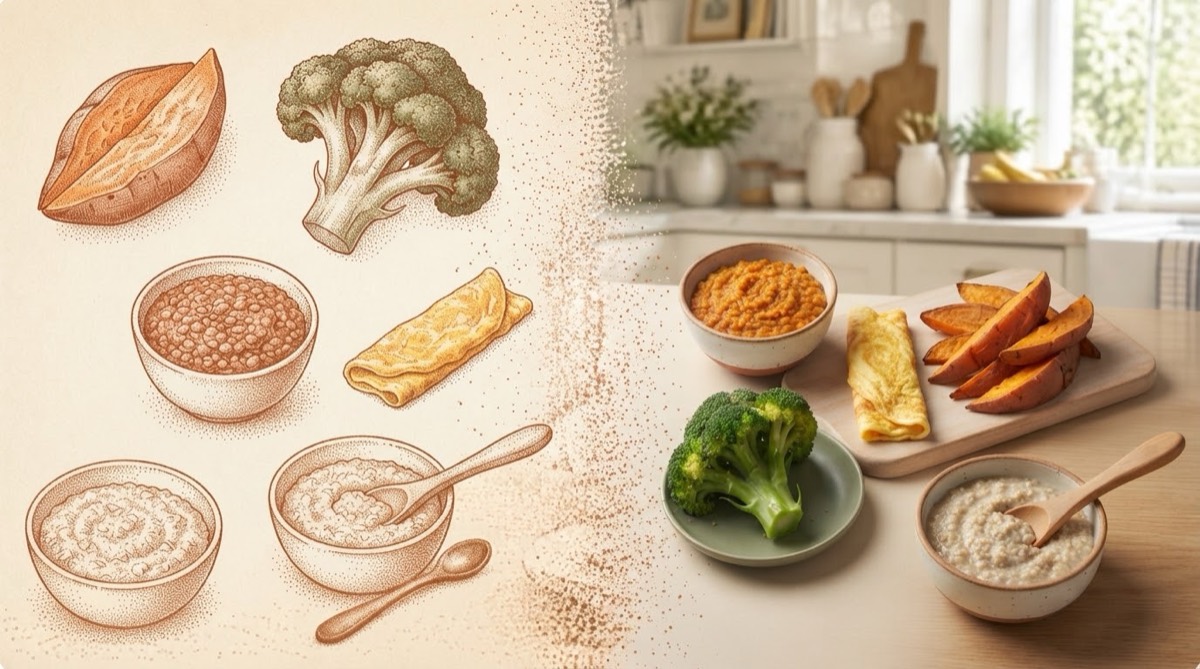
The first week is about getting comfortable, not quantities. Pick a time of day when baby is usually happy, sit baby upright in a high chair, and eat something yourself at the same time.
| Day | Try |
|---|---|
| Days 1–2 | A soft iron-rich food, like mashed lentils or a strip of omelet |
| Days 3–4 | Add a vegetable, such as roasted sweet potato wedges or a broccoli floret |
| Day 5 | Next allergen at home in the morning, such as thinned peanut butter in oatmeal |
| Days 6–7 | Repeat favorites and offer the allergen again |
If baby eats one lick and turns away, that counts. End the meal there and try again tomorrow.
Common mistakes to avoid
- Cutting milk feeds to “make room” for solids
- Offering solids when baby is very hungry or overtired
- Starting with only bland purees and no iron-rich foods
- Delaying peanut and egg until later in the year
- Measuring success by how much baby eats
When to call your pediatrician
Every baby’s routine looks different. Call your pediatrician if:
- Baby isn’t gaining weight, or is losing weight
- Fewer than 4 to 6 wet diapers a day, or dark urine
- Baby coughs, chokes or vomits at most meals
- Baby refuses almost all solids for more than 1 to 2 weeks
- You see signs of an allergic reaction after a new food
6 month feeding schedule: questions parents ask
How much should a 6-month-old eat?
Most 6-month-olds drink about 24 to 32 oz (710 to 950 mL) of formula a day or breastfeed on demand, often 6 to 8 times. Solids start as one small meal a day, usually 1 to 4 tablespoons in total, but some days baby will eat almost nothing, which is normal.
How many times a day should a 6-month-old eat solids?
Start with 1 solid meal a day. Many babies move to 2 meals around 7 months and 3 meals by about 9 months.
Should I give milk or solids first at 6 months?
Milk first. Offer solids about 30 to 60 minutes after a breast milk or formula feed, when baby is alert but not very hungry.
What should a 6-month-old eat first?
Good first foods are soft, iron-rich and easy to hold or scoop, like mashed lentils, soft-cooked meat, egg, avocado and roasted sweet potato. See our guide to the best first foods.
Can a 6-month-old have water?
Yes, a few sips with meals from an open or straw cup, up to about 4 oz (120 mL) a day. Water should not replace breast milk or formula.
When should I introduce allergens to my 6-month-old?
In the first weeks of solids. Introduce common allergens like peanut and egg one at a time, at home, early in the day. Babies with severe eczema should check with their pediatrician first.
How many naps does a 6-month-old need?
Most 6-month-olds take 3 naps a day, with wake windows of about 2 to 2.5 hours, and sleep 12 to 15 hours in total over 24 hours.
My 6-month-old isn’t interested in solids. Is that okay?
Yes. Interest varies a lot at the start. Keep offering one relaxed meal a day. If baby shows no interest by 7–8 months, or has trouble swallowing, talk to your pediatrician.
Keep reading
 Starting solids: the complete guide
 The best first foods for baby
 7-month-old feeding schedule
Recipe collectionsBaby purée recipesBaby oatmeal recipes
- AAP (HealthyChildren.org): Starting solid foods
- CDC: When, what, and how to introduce solid foods
- CDC: How much and how often to feed infant formula
- WHO: Complementary feeding
This guide is written for healthy, full-term babies and doesn’t replace your pediatrician. If your baby was born early, has a medical condition, feeding or swallowing difficulties, or a known allergy, check with them first (medical disclaimer). Reviewed by our dietitians.