
Fruit Food Library
When can babies have star fruit?
Can babies have star fruit?
We suggest waiting until about 12 months to offer star fruit, and then only in small amounts of the fresh, ripe fruit. Star fruit (carambola) contains a natural toxin and a lot of oxalate that the kidneys must clear, so it is never safe for any child with kidney problems, and star fruit juice should be avoided. Star fruit is not a common allergen.
How to serve star fruit by age
Shapes and textures change as your baby’s grasp and chewing grow.

6 months
Skip star fruit at this age and offer smooth purees of other fruits instead, such as ripe mango, banana or pear on a spoon. If your baby has any kidney condition, avoid star fruit entirely and ask your pediatrician which fruits are best.

7–8 months
Keep waiting on star fruit. Offer other soft fruits instead, such as mashed ripe mango or soft banana and pear pieces that squash easily, and avoid star fruit entirely if your baby has any kidney condition.

9–12 months
Keep waiting on star fruit until around the first birthday. Ripe papaya, peach and melon give similar juicy, tropical flavors without the same kidney concerns.

12 months +
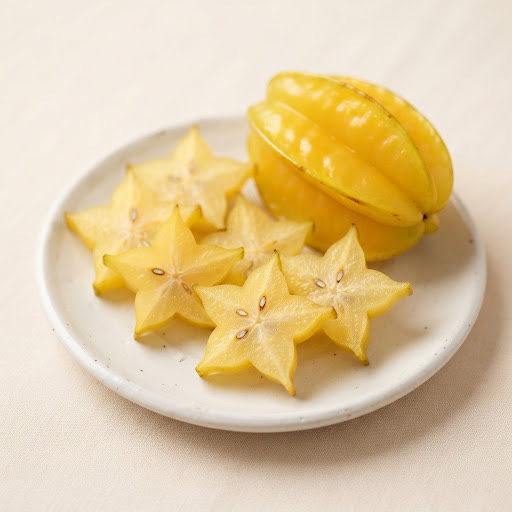
Offer a few thin, small pieces of ripe, yellow star fruit with the seeds removed, as part of a meal rather than on an empty stomach. Keep it to an occasional small portion, never as juice, and cut the waxy ridges thin so pieces are easy to chew.
Why it’s good
Star fruit gives toddlers vitamin C, fiber and water, with a sweet-tart flavor. It is also very high in oxalate and contains a natural nerve toxin, both of which healthy kidneys normally clear in small amounts. Because other fruits give the same vitamin C with none of these concerns, star fruit is best kept to occasional small tastes.
Safety notes
- Never give star fruit or star fruit juice to a child with kidney disease, reduced kidney function or a history of kidney stones. In people with weak kidneys, star fruit can cause serious nerve and kidney problems, even in small amounts.
- Avoid star fruit juice and large portions at any age. Kidney injury has been reported in healthy adults after large amounts or juice, especially on an empty stomach.
- If a child shows hiccups that will not stop, vomiting, confusion, weakness or unusual sleepiness after eating star fruit, seek medical care right away.
- Firm, underripe star fruit and thick slices of the waxy ridges are a choking risk. Choose fully yellow fruit and cut thin, small pieces with the seeds removed.
- Star fruit can interact with some medicines in a similar way to grapefruit. Ask your doctor if your child takes regular medication.
A low-allergy food, still worth watching
Star fruit is not one of the Top 9 allergens, and allergic reactions are rare. The bigger concern with star fruit is its effect on the kidneys, not allergy, but still watch for rash, hives, vomiting or swelling the first time.
Star fruit for babies: questions parents ask
Quick answers about star fruit for babies and toddlers.
When can babies have star fruit?
We suggest waiting until about 12 months before offering star fruit, and then giving only small amounts of the ripe fruit. Star fruit contains a natural toxin and lots of oxalate that a baby's still-maturing kidneys must clear, so there is no reason to rush it.
Can babies have star fruit?
Babies under 12 months are better off with other fruits, and children with any kidney problem should never eat star fruit. Healthy toddlers can have a few small pieces of ripe star fruit occasionally, as part of a meal.
Why is star fruit dangerous for people with kidney disease?
Star fruit contains a natural nerve toxin called caramboxin and a large amount of oxalic acid. Healthy kidneys usually clear these in small amounts, but weak kidneys cannot, which can lead to hiccups, confusion, seizures and kidney damage, so star fruit must be avoided completely with kidney disease.
Is star fruit a choking hazard for babies?
Star fruit can be a choking hazard because firm, underripe fruit and the waxy ridges are hard to chew. Serve only ripe star fruit cut into small, thin pieces with the seeds removed, and always supervise your child while they eat.
Is star fruit a common allergen?
No, star fruit is not a common allergen and is not one of the Top 9 allergens. Allergic reactions to star fruit are rare.
How do I serve star fruit to a 6 month old?
We do not recommend serving star fruit to a 6 month old. Choose smooth purees of fruits like mango, banana or pear at this age, and wait until around 12 months to offer a few small pieces of ripe star fruit.
Can toddlers drink star fruit juice?
No, toddlers should not drink star fruit juice. Juice concentrates the oxalate and toxin in star fruit, and kidney injury has been reported after drinking it, especially on an empty stomach.
How much star fruit can a toddler eat?
A healthy toddler can have a few small pieces of star fruit, such as a slice or two, now and then. Serve star fruit with a meal, not on an empty stomach, and do not make it an everyday fruit.
How do I know if star fruit is ripe?
Ripe star fruit is mostly yellow with only slight green on the ridges, smells fragrant and feels firm but not hard. Green star fruit is more sour, firmer and higher in oxalate, so wait until it ripens on the counter.
The takeaway
- We suggest waiting until about 12 months to offer star fruit, and then only in small amounts of the fresh, ripe fruit.
- Offer a few thin, small pieces of ripe, yellow star fruit with the seeds removed, as part of a meal rather than on an empty stomach.
- Choking risk is medium. Not a Top 9 allergen, but offer a small amount first and watch for any reaction.
Read next


Sources
This guide follows current advice from these organizations.
- Starting Solid Foods American Academy of Pediatrics (HealthyChildren.org)
- When, What, and How to Introduce Solid Foods Centers for Disease Control and Prevention
- Choking Hazards Centers for Disease Control and Prevention
- Choking Prevention American Academy of Pediatrics (HealthyChildren.org)
- Foods and Drinks to Avoid or Limit Centers for Disease Control and Prevention
Track every new food in your baby’s passport
Track the first 100 foods and the Top 9 allergens. 7 days free.
More fruit for babies
Updated November 2026. Reviewed by our dietitians. Based on AAP, CDC and NIAID guidance. Written for healthy, full-term babies; not a substitute for your pediatrician. If your baby was born early, has a medical condition, feeding difficulties or a known allergy, check with them first (medical disclaimer). Always stay with your baby while they eat.