
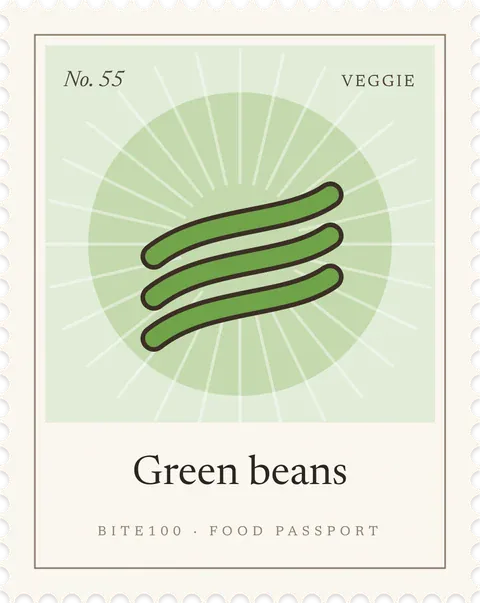
No. 55 · Veggies Passport food
When can babies eat green beans?
Can babies eat green beans?
Babies can have green beans from about 6 months, as soon as they are ready for solids. Start with green beans steamed until soft and blended into a smooth puree, then offer whole soft-cooked beans for little hands to hold from 7–8 months. Raw or crunchy green beans are a choking risk, so keep them well cooked until your child chews confidently.
How to serve green beans by age
Shapes and textures change as your baby’s grasp and chewing grow.

6 months
Trim the ends and steam or boil green beans for 8 to 10 minutes until very soft, then blend them into a smooth puree with a little breast milk, formula or water. Offer it on a spoon, on its own or mixed with potato or another smooth vegetable.

7–8 months
Steam or boil whole green beans until they squash easily between your thumb and finger, then offer them whole so your baby can grab one in a fist and gnaw. You can also fork-mash cooked green beans with potato for a lumpier texture.

9–12 months
Cut soft-cooked green beans into small pieces about the size of a pea, or slice them in half lengthwise so they are flatter and easier to chew. Mixing pieces into scrambled egg, rice or pasta adds variety.

12 months +
Serve cooked green beans whole or chopped as part of family meals, roasted with a little olive oil or tossed with butter and garlic. Raw green beans are hard and crunchy, so wait until your child chews well, usually around 3 to 4 years, and then slice them thinly.
Why it’s good
Green beans give babies vitamin C, vitamin K, folate, vitamin A and fiber, plus small amounts of iron and other minerals. Their mild taste and soft texture when cooked make them an easy way to get babies used to green vegetables. Early, repeated tastes of veggies help babies accept them later on.
Safety notes
- Never serve raw or crisp-tender green beans to babies. Cook them until fully soft, with no snap left when you bend one.
- Round slices of green beans can lodge in the airway. Serve them whole once your baby starts holding soft foods at 7–8 months, and cut them in half lengthwise or into small pieces for older babies.
- Canned green beans are often high in sodium. Choose no-salt-added cans, or drain and rinse them well before serving.
- Remove tough strings and stem ends, which can be hard for babies to chew.
- Home-cooked green beans are fine for babies from 6 months. Like other vegetables, refrigerate leftovers promptly and use homemade purees within 2 to 3 days or freeze them.
A low-allergy food, still worth watching
Green beans are not a common allergen, and allergic reactions to them are rare. Green beans are legumes, so if your baby has a known legume allergy, such as to peanut or peas, talk to your pediatrician before introducing them.
Green beans for babies: questions parents ask
Quick answers about green beans for babies and toddlers.
When can babies eat green beans?
Babies can have green beans from about 6 months, when they are ready to start solids. Cook green beans until very soft and blend them into a puree at first, then offer soft whole beans for baby to hold from about 7–8 months.
Can babies eat green beans?
Yes, babies can eat green beans from 6 months. Soft-cooked green beans are an easy first vegetable with a mild flavor, smooth as a puree at first and simple to hold once baby is ready for soft pieces.
Are green beans a choking hazard for babies?
Green beans can be a choking hazard for babies if they are served raw, undercooked or cut into round slices. Cook green beans until fully soft, puree them at first, serve them whole once baby starts holding food, and cut them lengthwise or into small pieces once baby uses a pincer grasp.
Are green beans a common allergen?
No, green beans are not a common allergen and are not one of the Top 9. Reactions are rare, but green beans are legumes, so talk to your doctor if your baby has a known legume allergy.
How do I serve green beans to a 6 month old?
To serve green beans to a 6 month old, trim the ends and steam the beans until very soft, then blend them into a smooth puree and offer it on a spoon. Whole soft-cooked green beans to hold and gnaw can follow at 7–8 months.
Are canned green beans OK for babies?
Canned green beans are OK for babies if you choose no-salt-added varieties or drain and rinse them to remove some sodium. Canned green beans are already soft, which makes them handy for beginners.
Are frozen green beans good for babies?
Frozen green beans are a great choice for babies because they are picked and frozen at their peak and have no added salt. Cook frozen green beans until fully soft before serving, and never give them frozen to a baby.
Do I need to worry about nitrates in green beans?
Home-prepared green beans are safe for babies 6 months and older. Nitrate concerns mainly apply to young infants under 3 months and to certain well water, so check with your pediatrician if you use private well water to make purees.
Can green beans cause gas in babies?
Green beans contain fiber and can cause a little gas as a baby's gut adjusts to new foods. This is normal, and green beans are gentler on the tummy than many dried beans.
The takeaway
- Babies can have green beans from about 6 months, as soon as they are ready for solids.
- Trim the ends and steam or boil green beans for 8 to 10 minutes until very soft, then blend them into a smooth puree with a little breast milk, formula or water.
- Choking risk is medium. Not a Top 9 allergen, but offer a small amount first and watch for any reaction.
Read next



Sources
This guide follows current advice from these organizations.
- Starting Solid Foods American Academy of Pediatrics (HealthyChildren.org)
- When, What, and How to Introduce Solid Foods Centers for Disease Control and Prevention
- Choking Hazards Centers for Disease Control and Prevention
- Choking Prevention American Academy of Pediatrics (HealthyChildren.org)
- Foods and Drinks to Avoid or Limit Centers for Disease Control and Prevention
- Infant Methemoglobinemia: The Role of Dietary Nitrate in Food and Water Greer FR, Shannon M; American Academy of Pediatrics. Pediatrics. 2005;116(3):784-786
Stamp green beans in your baby’s passport
Track the first 100 foods and the Top 9 allergens. 7 days free.
More vegetables for babies
Updated November 2026. Reviewed by our dietitians. Based on AAP, CDC and NIAID guidance. Written for healthy, full-term babies; not a substitute for your pediatrician. If your baby was born early, has a medical condition, feeding difficulties or a known allergy, check with them first (medical disclaimer). Always stay with your baby while they eat.