
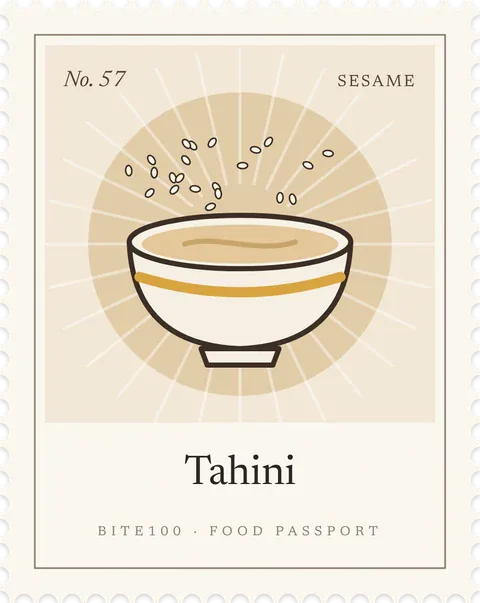
No. 57 · Nuts & seeds Passport food
When can babies have tahini?
Can babies have tahini?
Babies can have tahini from about 6 months, as soon as they are ready for solids. Always thin tahini with water, breast milk, formula or yogurt, or stir it into other foods, because thick spoonfuls of seed butter can stick in the mouth and throat. Sesame is a Top 9 allergen, and tahini is one of the easiest ways to introduce it early and keep it in the diet.
How to serve tahini by age
Shapes and textures change as your baby’s grasp and chewing grow.

6 months
Start with about 1/4 teaspoon of plain tahini thinned with warm water, breast milk or formula until runny, then stir it into oatmeal, plain yogurt or smooth vegetable puree. Increase the amount over the next few days if there is no reaction.

7–8 months
Keep stirring thinned tahini into thicker porridge, lumpier mashes and lentils, or spread a very thin layer on soft toast strips your baby can hold. Never offer it by the spoonful straight from the jar.

9–12 months
Spread a very thin layer of tahini on toast fingers or soft pancakes, or mix it into dips, lentils and roasted vegetables. Low-salt homemade hummus is another easy way to keep sesame in the diet.

12 months +
Use tahini in hummus, salad dressings, sauces for noodles and grain bowls, or thinly on toast. Keep spreading it thin rather than offering spoonfuls straight from the jar.
Why it’s good
Tahini gives babies healthy fats for brain development, plus protein, iron, zinc, copper, calcium and B vitamins. A small amount adds energy and minerals to everyday foods without much volume. Pairing tahini with vitamin C rich foods, like lemon, tomato or kiwi, helps babies absorb the iron.
Safety notes
- Never offer tahini straight from the jar or by the spoonful to babies. Thick seed butters can form a sticky glob that is hard to swallow; always thin it or mix it in.
- Introduce tahini as its own new allergen. Offer it at home, earlier in the day, so you can watch your baby for a few hours afterward.
- Choose plain tahini made from just sesame seeds, ideally with no added salt or sugar. Halva and sesame candies are sugary and best avoided before age 2.
- Store-bought hummus can be salty. Look for lower-sodium brands or make your own with no added salt.
- Tahini has been recalled in the past for Salmonella. Buy from a trusted brand, stir it well, keep the jar closed, and check recall notices if you are unsure.
Introduce tahini on its own, then keep it in
Sesame is one of the Top 9 allergens and has been required on US food labels since 2023. Introduce a small amount, watch for hives, vomiting, swelling, coughing or wheezing, and once tolerated keep offering sesame a few times a week; if your baby has severe eczema or another food allergy, talk to your pediatrician before the first taste.
Tahini for babies: questions parents ask
Quick answers about tahini for babies and toddlers.
When can babies have tahini?
Babies can have tahini from about 6 months, as soon as they are ready for solids. Tahini should be thinned or mixed into other foods, and it is a great early way to introduce sesame.
Can babies have tahini?
Yes, babies can eat tahini from 6 months when it is thinned or stirred into soft foods. Tahini is made from ground sesame seeds and is one of the simplest ways to offer the sesame allergen.
Is tahini a choking hazard for babies?
Tahini can be a choking hazard for babies when it is served thick, like a spoonful straight from the jar. Thin tahini with water, breast milk or formula, mix it into oatmeal or yogurt, or spread it very thinly on toast.
Is tahini a common allergen?
Yes, tahini is a common allergen because it is made from sesame, one of the Top 9 food allergens. Introduce tahini in a small amount on its own and keep it in the diet regularly once your baby tolerates it.
How do I serve tahini to a 6 month old?
To serve tahini to a 6 month old, mix about 1/4 teaspoon of tahini with warm water, breast milk or formula until runny, then stir it into oatmeal, yogurt or mashed sweet potato. If your baby has no reaction, slowly increase the amount over the next few servings.
How do I introduce sesame to my baby?
Tahini is the easiest way to introduce sesame to a baby, offered thinned and mixed into a food your baby already eats well. Start with a small amount, wait and watch, then serve sesame foods a few times a week to help keep tolerance.
Can babies have hummus with tahini?
Babies can have hummus with tahini from 6 months, ideally after sesame has been introduced on its own. Homemade hummus without added salt is best, and store-bought hummus should be a lower-sodium variety.
Can babies have sesame seeds?
Babies can eat ground sesame seeds or tahini from 6 months. Whole sesame seeds are tiny and not a classic choking hazard, but they can be inhaled and pass through undigested, so ground seeds and tahini are better for young babies.
How much tahini can a baby have?
A baby only needs a small amount of tahini, starting with about 1/4 teaspoon and working up to a teaspoon or two mixed into meals. Offering tahini or other sesame foods a few times a week is more important than large portions.
The takeaway
- Babies can have tahini from about 6 months, as soon as they are ready for solids.
- Start with about 1/4 teaspoon of plain tahini thinned with warm water, breast milk or formula until runny, then stir it into oatmeal, plain yogurt or smooth vegetable puree.
- Choking risk is medium. Sesame is one of the Top 9 allergens: offer a small amount first, watch for a reaction, then keep it in the diet regularly.
Read next


Sources
This guide follows current advice from these organizations.
- Starting Solid Foods American Academy of Pediatrics (HealthyChildren.org)
- When, What, and How to Introduce Solid Foods Centers for Disease Control and Prevention
- Choking Hazards Centers for Disease Control and Prevention
- Choking Prevention American Academy of Pediatrics (HealthyChildren.org)
- Foods and Drinks to Avoid or Limit Centers for Disease Control and Prevention
- Iron Centers for Disease Control and Prevention
- The Effects of Early Nutritional Interventions on the Development of Atopic Disease in Infants and Children Greer FR, Sicherer SH, Burks AW; American Academy of Pediatrics. Pediatrics. 2019;143(4):e20190281
Stamp tahini in your baby’s passport
Track the first 100 foods and the Top 9 allergens. 7 days free.
Recipes with tahini

More nuts and seeds for babies
Updated November 2026. Reviewed by our dietitians. Based on AAP, CDC and NIAID guidance. Written for healthy, full-term babies; not a substitute for your pediatrician. If your baby was born early, has a medical condition, feeding difficulties or a known allergy, check with them first (medical disclaimer). Always stay with your baby while they eat.