
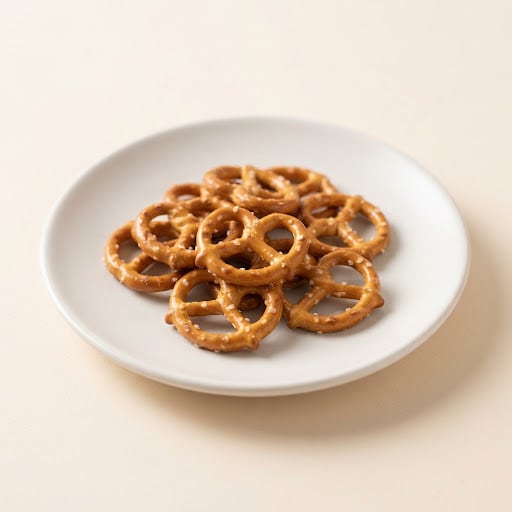
Grains Food Library
When can babies have hard pretzels?
Can babies have hard pretzels?
Hard pretzels are best saved until at least 12 months, and many families wait longer. Hard pretzels are a choking hazard because they are hard and break into sharp pieces. Most are salty and contain wheat.
How to serve hard pretzels by age
Shapes and textures change as your baby’s grasp and chewing grow.

6 months
Do not offer hard pretzels or teething biscuits. Offer smooth purees and iron-rich mashes on a spoon, and use a chilled teether for sore gums.

7–8 months
Hard pretzels are still off-limits. For something to hold, offer soft foods that squash easily, like a soft toast strip with a thin spread or a ripe banana piece.

9–12 months
Hard pretzels are still off-limits. Offer soft finger foods instead.

12 months +
Hard pretzels are best saved until about age 3 to 4, when your child chews well. For gnawing, use a teether, or offer soft bread strips or a soft pretzel torn into small pieces. Small pretzel twists and sticks are best saved until age 3 or older.
Why it’s good
Hard pretzels mostly provide carbohydrates and salt. Whole-grain varieties offer a little fiber. They are best as an occasional snack.
Safety notes
- Hard pretzels are a choking hazard because they are hard and break into sharp pieces.
- Choose unsalted pretzels to limit sodium.
- Offer pretzel rods instead of small twists for toddlers.
- Supervise closely and have toddlers sit while eating.
Introduce pretzels on its own, then keep it in
Hard pretzels contain wheat, a Top 9 allergen, and may contain dairy, soy or sesame. Check labels.
Hard pretzels for babies: questions parents ask
Quick answers about hard pretzels for babies and toddlers.
When can babies have hard pretzels?
Hard pretzels are best saved until at least 12 months. Small pretzel twists are safer from age 3 or older.
Can babies have pretzels?
Babies under 12 months should not eat hard pretzels. Toddlers can try pretzel rods with close supervision.
Are pretzels a choking hazard for babies?
Yes, hard pretzels are a choking hazard because they are hard and break into sharp pieces. Supervise toddlers closely.
Are pretzels a common allergen?
Pretzels contain wheat, a common allergen, and may contain dairy, soy or sesame. Read labels carefully.
How do I serve pretzels to a 6 month old?
Hard pretzels should not be served to a 6 month old. Smooth purees on a spoon are the right texture at this age, and soft toast strips are a safer choice to hold from about 7–8 months.
Are unsalted pretzels better for toddlers?
Yes, unsalted pretzels are better for toddlers because regular pretzels are high in sodium. Unsalted pretzels still pose a choking risk.
Can pretzels be used for teething?
Hard pretzels are not recommended for teething because pieces can break off. Use a teething toy or chilled washcloth instead.
Are pretzels healthier than chips for toddlers?
Pretzels are lower in fat than chips but still high in salt and low in nutrients. Both are occasional snacks.
The takeaway
- Hard pretzels are best saved until at least 12 months, and many families wait longer.
- Hard pretzels are best saved until about age 3 to 4, when your child chews well.
- Choking risk is high. Wheat is one of the Top 9 allergens: offer a small amount first, watch for a reaction, then keep it in the diet regularly.
Read next


Sources
This guide follows current advice from these organizations.
- Starting Solid Foods American Academy of Pediatrics (HealthyChildren.org)
- When, What, and How to Introduce Solid Foods Centers for Disease Control and Prevention
- Choking Hazards Centers for Disease Control and Prevention
- Choking Prevention American Academy of Pediatrics (HealthyChildren.org)
- Foods and Drinks to Avoid or Limit Centers for Disease Control and Prevention
- The Effects of Early Nutritional Interventions on the Development of Atopic Disease in Infants and Children Greer FR, Sicherer SH, Burks AW; American Academy of Pediatrics. Pediatrics. 2019;143(4):e20190281
Track every new food in your baby’s passport
Track the first 100 foods and the Top 9 allergens. 7 days free.
More grains for babies
Updated November 2026. Reviewed by our dietitians. Based on AAP, CDC and NIAID guidance. Written for healthy, full-term babies; not a substitute for your pediatrician. If your baby was born early, has a medical condition, feeding difficulties or a known allergy, check with them first (medical disclaimer). Always stay with your baby while they eat.