
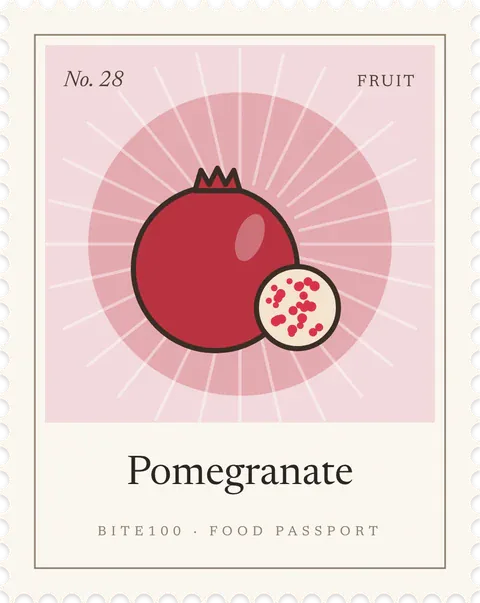
No. 28 · Fruit Passport food
When can babies have pomegranate?
Can babies have pomegranate?
Babies can have pomegranate from about 6 months, as soon as they are ready for solids. At 6 months, blend and strain the juicy seeds (arils) and stir the pulp into smooth foods; from 7–8 months, crushed arils can be mixed into soft foods. Whole arils are small, firm and slippery, so most babies try them only once their pincer grasp and chewing improve.
How to serve pomegranate by age
Shapes and textures change as your baby’s grasp and chewing grow.

6 months
Blend pomegranate arils and press them through a sieve to remove the hard inner seeds, then stir the smooth juice-pulp into plain yogurt, oatmeal or mashed banana. Offer it on a spoon.

7–8 months
Crush pomegranate arils well with a fork or the back of a spoon and stir them into plain yogurt, oatmeal or lumpier mashed fruit. Do not offer whole arils yet.

9–12 months
Once baby has a pincer grasp, flatten a few arils on the tray for picking up, or scatter crushed arils over soft foods like ricotta or porridge. Offer only a few at a time so baby does not stuff a handful into the mouth.

12 months +
Toddlers can eat whole arils, sprinkled over yogurt, salads, grain bowls or roasted vegetables. Serve them at the table and keep portions small at first while your toddler learns to chew the crunchy center.
Why it’s good
Pomegranate gives babies vitamin C, vitamin K, folate and some fiber, along with deeply colored plant pigments called polyphenols. The vitamin C helps the body absorb iron from foods like lentils, beans and fortified cereal served at the same meal.
Safety notes
- Whole arils are small, round, firm and slippery. For babies under 9 months, crush them or blend and strain them before serving.
- Remove all white pith and skin, which are bitter and tough.
- Offer only a few arils at a time to older babies and toddlers to avoid mouth-stuffing.
- Pomegranate juice stains clothes and can look alarming in stools or diapers; red-tinged poop after pomegranate is common and harmless. Call your pediatrician if you see red in the stool without having served red foods.
- Skip pomegranate juice and molasses before 12 months, and always stay within arm's reach while baby eats.
A low-allergy food, still worth watching
Pomegranate is not a common allergen, though rare reactions are reported, sometimes in people with pollen or other fruit allergies. Watch for hives, itching, swelling or vomiting, and seek urgent care for any breathing difficulty.
Pomegranate for babies: questions parents ask
Quick answers about pomegranate for babies and toddlers.
When can babies have pomegranate?
Babies can have pomegranate from about 6 months of age, once they are ready for solids. Pomegranate arils should be crushed or blended for young babies, because whole arils are small and slippery.
Can babies have pomegranate?
Yes, babies can eat pomegranate from around 6 months when it is prepared safely for their age. Crushed arils mixed into soft foods suit younger babies, while whole arils are usually best saved for confident chewers.
Is pomegranate a choking hazard for babies?
Pomegranate is a medium choking risk for babies because whole arils are small, firm and slippery, and the crunchy seed inside can be hard to manage. Crushing the arils for young babies and offering just a few at a time to older babies lowers the risk.
Is pomegranate a common allergen?
No, pomegranate is not one of the Top 9 common food allergens. Pomegranate allergy is rare, but watch for hives, swelling or vomiting the first few times you offer it.
How do I serve pomegranate to a 6 month old?
To serve pomegranate to a 6 month old, blend the arils and strain out the hard inner seeds, then stir the smooth pulp into plain yogurt, oatmeal or mashed banana and offer it on a spoon. Arils crushed with a fork can follow at 7–8 months.
Can babies have pomegranate seeds whole?
Most babies can try whole pomegranate seeds once they have a good pincer grasp and are chewing well, often from about 12 months. Start with a few seeds at a time on the tray and stay close.
When can babies drink pomegranate juice?
Babies should not drink pomegranate juice before 12 months, following AAP guidance on juice. After 12 months, small amounts of 100 percent juice with a meal are fine, but whole or crushed arils give more fiber.
Why is my baby's poop red after eating pomegranate?
Red or dark pink poop after eating pomegranate is usually just pigment from the fruit passing through and is harmless. Call your pediatrician if red appears in the stool when your baby has not eaten red foods, or if your baby seems unwell.
How do I get the seeds out of a pomegranate easily?
To get the seeds out of a pomegranate, cut it in half and tap the back firmly with a wooden spoon over a bowl, or break it apart in a bowl of water so the arils sink and the pith floats. Remove any white pith before serving to your baby.
The takeaway
- Babies can have pomegranate from about 6 months, as soon as they are ready for solids.
- Blend pomegranate arils and press them through a sieve to remove the hard inner seeds, then stir the smooth juice-pulp into plain yogurt, oatmeal or mashed banana.
- Choking risk is medium. Not a Top 9 allergen, but offer a small amount first and watch for any reaction.
Read next



Sources
This guide follows current advice from these organizations.
- Starting Solid Foods American Academy of Pediatrics (HealthyChildren.org)
- When, What, and How to Introduce Solid Foods Centers for Disease Control and Prevention
- Choking Hazards Centers for Disease Control and Prevention
- Choking Prevention American Academy of Pediatrics (HealthyChildren.org)
Stamp pomegranate in your baby’s passport
Track the first 100 foods and the Top 9 allergens. 7 days free.
More fruit for babies

Updated November 2026. Reviewed by our dietitians. Based on AAP, CDC and NIAID guidance. Written for healthy, full-term babies; not a substitute for your pediatrician. If your baby was born early, has a medical condition, feeding difficulties or a known allergy, check with them first (medical disclaimer). Always stay with your baby while they eat.