Free Top 9 allergen planner
Allergen introduction schedule for your baby
Answer three questions to get a dated, one-at-a-time plan for all nine.
Check with your pediatrician first. Babies with severe eczema or an egg allergy may need an allergy evaluation, and sometimes a supervised first taste of peanut, before starting at home. Many start as early as 4–6 months once cleared.
Your plan
Each new allergen
- Offer it at home, earlier in the day, when baby is well.
- Start with a small taste, then a bit more after 10–15 minutes if all is fine.
- Watch for about 2 hours afterwards.
- Once it’s in, keep offering it 2–3 times a week.
Call 911 if you see
- Trouble breathing, wheezing or a hoarse cry
- Swelling of the lips, tongue or face
- Repeated vomiting or sudden floppiness
Mild hives or a rash around the mouth: stop, and call your pediatrician.
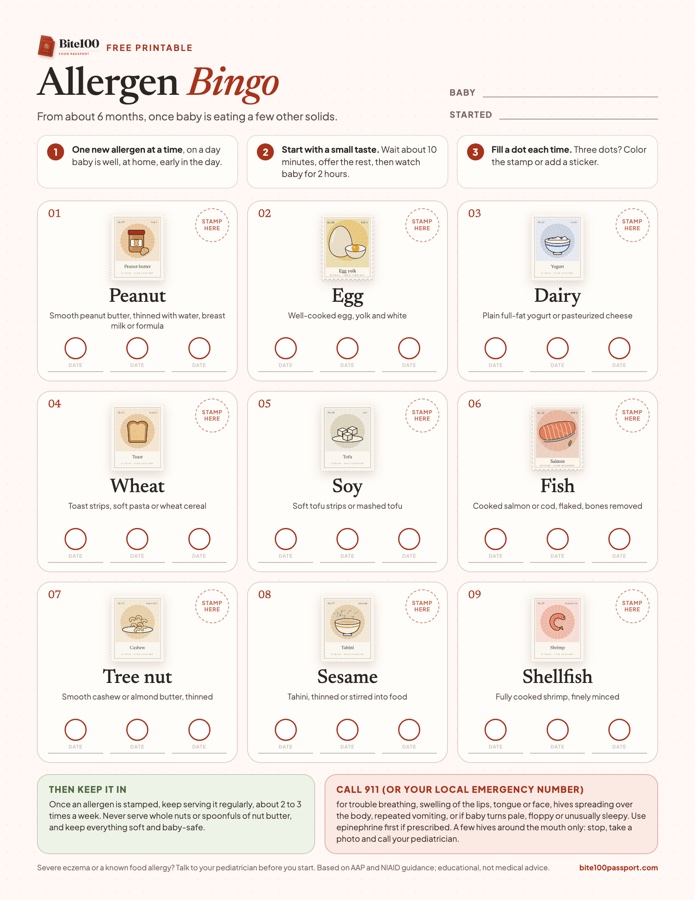
Free printable
Allergen bingo for your fridge
Nine allergens, one at a time. Fill a dot each time your baby has it, three dots earns the stamp. One page, US Letter.
Educational guidance based on AAP and NIAID recommendations, reviewed by our dietitians. It’s written for healthy, full-term babies and doesn’t replace your pediatrician, who knows your baby. If your baby was born early or has a medical condition, feeding difficulty or known allergy, check with them first (medical disclaimer).
Allergen introduction basics
Offering common allergens early and often, from around 6 months, can lower the chance of a food allergy, especially to peanut and egg. The hard part is keeping track of nine of them. Answer three questions and this free planner builds a dated, one-at-a-time schedule for all of the Top 9, with a first way to serve each one and what to watch for. For the reasoning behind each step, read our guide on how to introduce allergens to baby.
The AAP and NIAID recommend introducing allergens like peanut and egg once your baby has started solids, at around 6 months, and keeping them in the diet. The same simple routine works for each one:
- One new allergen at a time. Offer it at home, earlier in the day, on a day your baby is well, so any reaction is easy to spot.
- Start small. Give a small taste, wait 10–15 minutes, then offer the rest of the portion if all is fine.
- Watch for about 2 hours. Most reactions show up within minutes to 2 hours. Leave a few days before the next new allergen.
- Keep it in. Once an allergen is tolerated, offer it 2–3 times a week. Stopping can let an allergy develop later.
The Top 9 allergens and a first way to serve each
| Allergen | A safe first serving |
|---|---|
| Peanut | Smooth peanut butter thinned with water, breast milk or formula and stirred into a purée or oatmeal. Never whole peanuts or thick spoonfuls. |
| Egg | Hard-boiled egg mashed smooth, or soft scrambled egg cooked all the way through. |
| Milk (dairy) | Plain whole-milk yogurt or a little cheese. Cow’s milk as a drink waits until 12 months. |
| Wheat | Wheat cereal, very soft pasta, or soft toast fingers. |
| Soy | Mashed soft tofu or plain soy yogurt. |
| Tree nuts | Smooth almond or cashew butter, thinned and stirred in, or finely ground nuts. Introduce each tree nut separately. |
| Fish | Well-cooked salmon or cod, bones removed, flaked and mashed into a purée. |
| Shellfish | Fully cooked shrimp, finely chopped or blended into a purée. |
| Sesame | Tahini thinned into a purée or oatmeal, or smooth hummus with no added salt. |
Want the full walkthrough? Read the allergen introduction guide, or the step-by-step guides for peanut and egg.
Allergen introduction planner: questions parents ask
When should I start introducing allergens to my baby?
Around 6 months, once your baby is ready for solids and has tried a few first foods, not before 4 months. If your baby has severe eczema or an egg allergy, talk to your pediatrician first: they may suggest an allergy evaluation and starting peanut as early as 4–6 months.
How long should I wait between introducing allergens?
Leave a few days, often about 3, between each new allergen so you can tell which food caused any reaction. There is no need for long gaps. The planner lets you choose a gentle, standard or quick pace.
How often should my baby eat allergens once introduced?
Keep each allergen in your baby’s diet regularly, ideally 2 to 3 times a week. Regular exposure helps the body keep tolerating the food.
Which allergen should I introduce first?
There is no required order. Many families start with peanut and egg, because the evidence for early introduction is strongest for those two, then add dairy, wheat, soy, sesame, fish, shellfish and tree nuts.
What are the signs of an allergic reaction in a baby?
Hives or a rash, swelling of the lips, tongue or face, repeated vomiting, coughing or wheezing, a hoarse cry, or sudden floppiness. Call 911 for any trouble breathing or swelling of the face. Mild hives around the mouth only: stop the food and call your pediatrician. See signs of an allergic reaction.
Can I introduce two allergens on the same day?
Introduce new allergens one at a time. Once your baby has tolerated several, it is fine to combine them in the same meal, such as egg with wheat toast.
Keep it in your baby’s passport
This tool is free with no sign-up. Start the app to save your results, log meals and get allergen reminders. 7 days free, no card needed.
More free tools