Free baby portion calculator
How much should my baby eat?
Pick your baby’s age to see typical meals, portions and breast milk or formula for the day.
Educational guidance based on AAP and CDC recommendations. Reviewed by our dietitians. It’s written for healthy, full-term babies and doesn’t replace your pediatrician, who knows your baby. If your baby was born early or has a medical condition, feeding difficulty or known allergy, check with them first (medical disclaimer).
Pick your baby’s age to see how many meals a day, about how much solid food per meal, and how much breast milk, formula and water most babies have from 6–12 months. These are typical ranges, not targets: your baby’s hunger and fullness cues decide how much.
Baby portion sizes by age
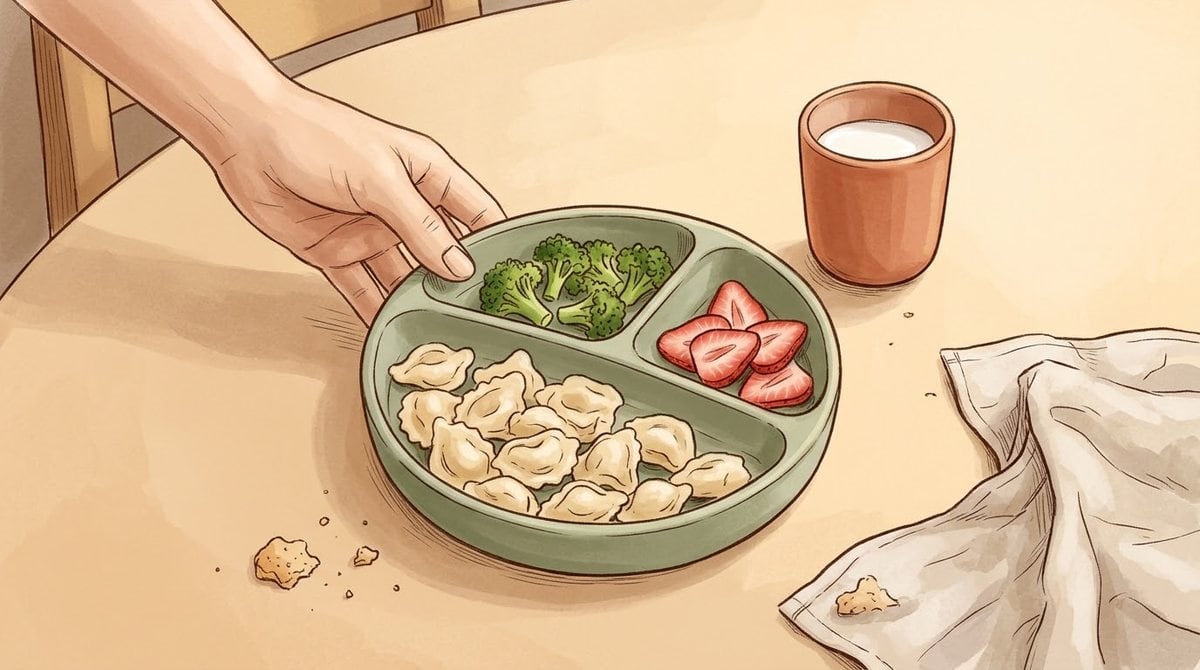
Portions grow slowly, from a few spoonfuls at 6 months to about a quarter to half a cup per meal by 9–12 months, while breast milk or formula stays the main food.
To see where these portions fit in the day, use our baby feeding schedule by month. Over 12 months? Try the toddler portion sizes calculator.
| Age | Meals | Solids per meal | Breast milk / formula |
|---|---|---|---|
| 6 months | 1 meal a day | A few teaspoons to 1–2 tablespoons | Breastfeed on demand, or 24–32 oz formula |
| 7 months | 1–2 meals a day | A few licks up to about ¼ cup | 4–6 breastfeeds, or 24–32 oz formula |
| 8 months | 2–3 meals a day | About ¼–½ cup | 3–5 breastfeeds, or 24–32 oz formula |
| 9 months | 3 meals + 1 optional snack | About ¼–½ cup | 3–4 breastfeeds, or 24–30 oz formula |
| 10–11 months | 3 meals + 1–2 snacks | About ¼–½ cup | 3–4 breastfeeds, or 20–28 oz formula |
| 12 months | 3 meals + 2 snacks | About ¼–½ cup | 16–24 oz whole cow’s milk, or breastfeeds |
How to tell your baby is getting enough
- Wet diapers. About 5 to 6 or more wet diapers a day is a good sign of enough milk and fluids.
- Steady growth. Your pediatrician checks weight and length on the growth chart at each visit.
- Hunger and fullness cues. Leaning in and opening the mouth means more; turning away means done.
- Variety over amount. A few bites of many foods, including iron-rich foods and allergens, matters more than finishing a bowl. Track them with 100 first foods.
Baby portion sizes: questions parents ask
How much should a 6 month old eat?
A 6-month-old has breast milk on demand, often 6 to 8 feeds, or about 24 to 32 oz of formula a day, plus 1 solid meal of a few teaspoons to 1 or 2 tablespoons. Breast milk or formula is still the main food.
How much should an 8 month old eat?
Most 8-month-olds eat 2 to 3 meals a day, roughly 2 to 4 tablespoons of each of 2 or 3 foods per meal, about a quarter to half a cup in total, plus 3 to 5 breastfeeds or 24 to 32 oz of formula.
How much should a 9 month old eat?
Most 9-month-olds eat 3 meals a day and maybe 1 small snack, roughly a quarter to half a cup per meal, plus 3 to 4 breastfeeds or about 24 to 30 oz of formula.
Should I give milk or solids first?
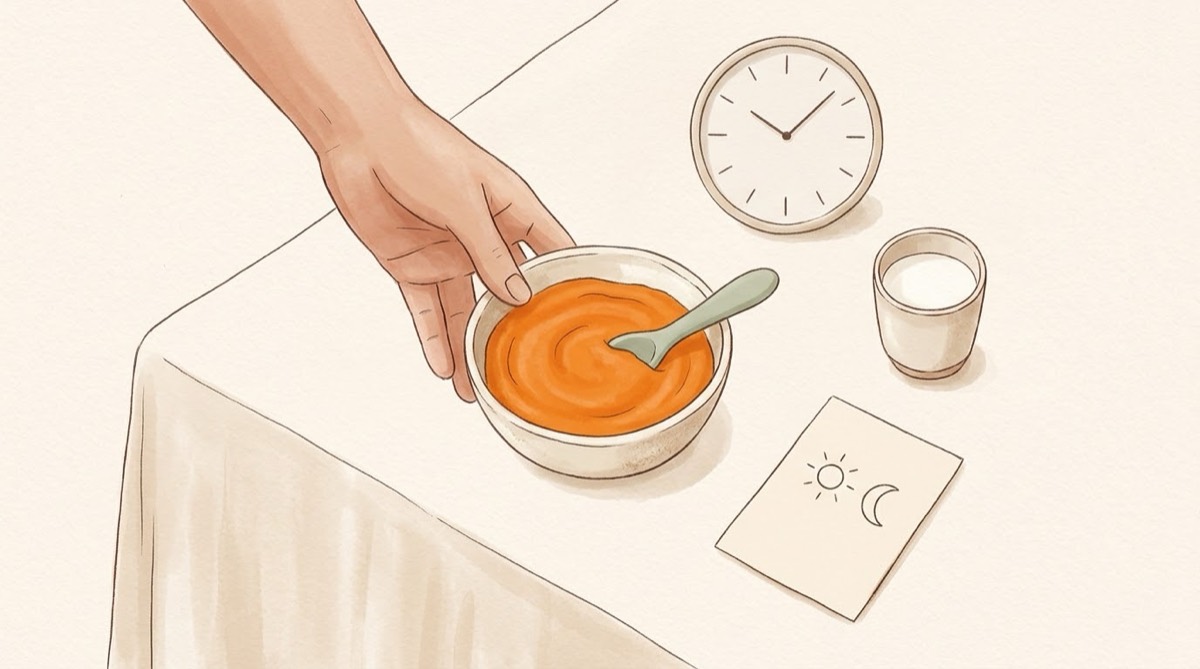
Before 12 months, give breast milk or formula first, then offer solids 30 to 60 minutes later, when your baby is hungry but not starving.
What if my baby eats very little?
That is common at first, and appetite changes day to day. Keep offering a variety of foods and let your baby decide how much. Ask your pediatrician if your baby isn’t growing well or has fewer wet diapers.
Keep it in your baby’s passport
This tool is free with no sign-up. Start the app to log meals, track 100 first foods and get allergen reminders. 7 days free, no card needed.
More free tools